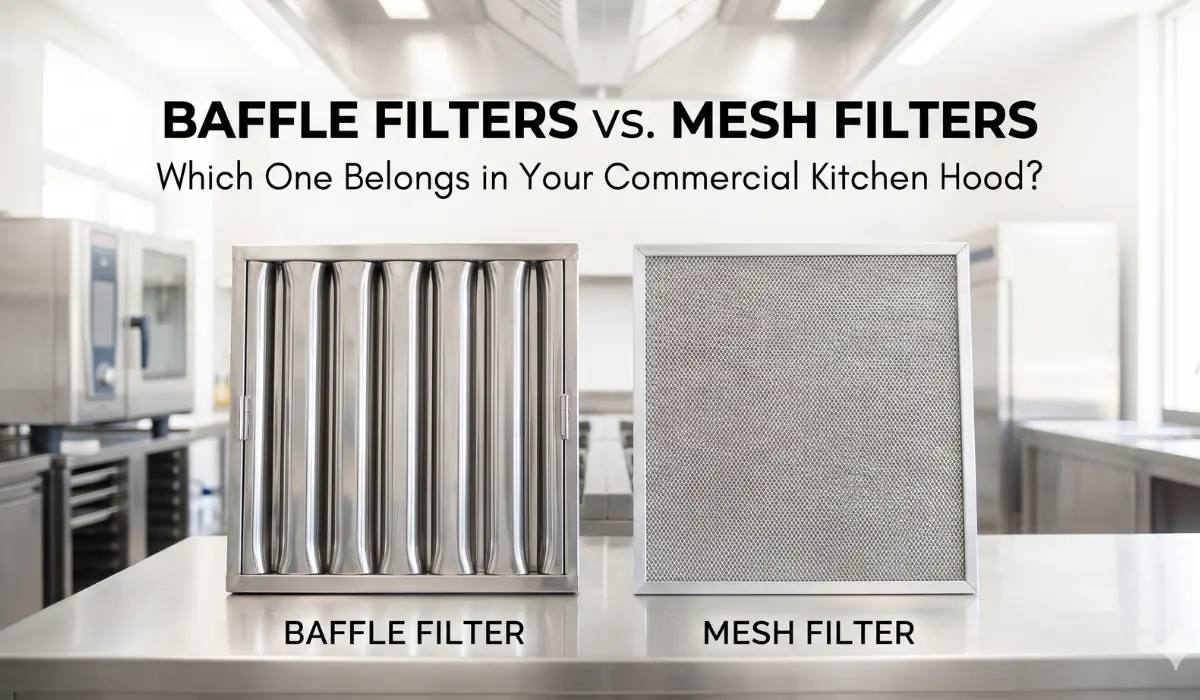
Baffle Filters vs. Mesh Filters: Which One Belongs in Your Commercial Kitchen Hood?
The filters in your hood are the first line of defence for your exhaust system. They catch grease before it reaches the ductwork and the rooftop fan. If they are the wrong type, or clogged, everything behind them takes the load.
Two types come up most often: baffle filters and mesh filters. They can look alike from the kitchen floor, but they behave very differently in a fire. This guide explains the difference, which one a commercial kitchen should use, and how to keep yours working.
The short answer
For a commercial kitchen hood, use baffle filters. Mesh filters are not suited to commercial cooking exhaust, and NFPA 96, which the Ontario Fire Code references, does not permit them in grease hoods. Confirm the exact wording with Toronto Fire Services or your insurer, and check that your filters are listed for grease extraction.
What is a baffle filter?
A baffle filter is a set of overlapping stainless steel plates, or baffles, set in a frame. Air from the cooking line is forced to change direction as it passes through. Grease droplets cannot turn as fast as the air does, so they hit the plates, collect and run down into a trough or cup.
Strengths:
- Built from steel, so it can withstand heat and flame
- Grease drains away instead of soaking in
- Easy to remove, wash and reuse
- Can go through a commercial dishwasher
- Designed for commercial cooking and listed for grease extraction
Weaknesses:
- Costs more up front than mesh
- Needs regular washing, since a clogged baffle still restricts airflow
- Can be damaged if dented or bent
What is a mesh filter?
A mesh filter is made of layers of woven metal, usually aluminum, packed into a frame. Grease is caught by the mesh strands and held inside the layers.
Strengths:
- Cheap to buy
- Common in light-duty or residential-style range hoods
Weaknesses:
- Soaks up grease instead of draining it, so it fills quickly
- Hard to clean properly, because grease sits deep in the layers
- A grease-soaked mesh is fuel, which can feed a fire instead of stopping it
- Often not listed for commercial grease extraction
- Can restrict airflow more as it clogs
Baffle vs. mesh: side by side
| Feature | Baffle filter | Mesh filter |
| Material | Stainless steel baffles | Layered woven metal, often aluminum |
| How it catches grease | Grease hits the plates and drains | Grease is held in the mesh |
| Fire behaviour | Resists and slows flame | Soaked grease can burn |
| Cleaning | Wash in sink or dishwasher | Hard to clean fully |
| Lifespan | Years, if cared for | Short, often replaced |
| Commercial hood use | Yes, if listed | Not suitable under NFPA 96 |
| Upfront cost | Higher | Lower |
Why mesh is a false saving
Mesh filters are the cheaper choice on the day you buy them. They get more expensive after that:
- Replacement cost: If they cannot be cleaned properly, you buy new ones again and again.
- Cleaning labour: Staff spend time on a job that never gets results.
- Fire risk: A mesh full of grease is fuel at the entrance to your exhaust.
- Inspection failures: An inspector who sees mesh in a commercial hood will mark it.
- Insurance: A claim can be disputed if the exhaust was not maintained to the required standard.
The filter is the cheapest part of the system to get right and one of the most expensive to get wrong.
How to tell what you have
Check your hood and look at the filters:
- Stainless steel plates in an S or zigzag shape are baffle filters.
- Layers of woven metal wire are mesh filters.
- Look for a label or stamp. Listed filters usually carry a marking from the manufacturer or a testing body.
- Check the frame. Baffle filters are heavy and rigid. Mesh filters feel light.
- If you are unsure, ask your hood cleaner or send them a photo.
How often should you clean baffle filters?
Filters are the one part of the system your staff can and should handle between professional cleanings. A common range is:
| Cooking type | Typical filter cleaning |
| Wok, charbroil or heavy fryer use | Daily to weekly |
| Moderate cooking, such as grills and flat tops | Weekly |
| Light cooking | Every one to two weeks |
If you can see grease dripping from the filters, or they feel greasy to the touch, clean them now. Professional hood cleaning still needs to happen on your NFPA 96 schedule, so filter cleaning does not replace it.
How to clean baffle filters
- Remove the filters carefully and wear gloves.
- Soak them in a degreasing solution, or put them through a commercial dishwasher.
- Scrub any baked-on residue with a soft brush. Do not use a wire brush that scratches the steel.
- Rinse and let them dry completely.
- Inspect each filter for dents, bends or damage. Replace any that are bent.
- Reinstall in the correct direction, and make sure there are no gaps between filters.
Set a schedule and write down who is responsible, otherwise it will not happen.
Common filter mistakes to avoid
- Missing filters. Open gaps let grease bypass the filters and go straight into the duct.
- Wrong size. A filter that does not fit its slot leaves gaps.
- Installed backwards or flat. Baffle filters need to sit at an angle so grease can drain into the trough. Check the manufacturer’s instructions and the requirements for your hood.
- Never cleaned. A clogged baffle restricts airflow and does not protect the duct.
- Foil or cloth covers. Wrapping filters to keep them clean blocks airflow and creates a fire risk.
- Damaged filters left in place. Replace dented or warped filters.
How filters connect to professional cleaning
Filters protect the system, but they do not stop all grease. Some vapour passes through and settles in the plenum, the ducts and the rooftop fan. That is why a hood cleaning service still needs to clean the whole system on the schedule that fits your cooking, with filters cleaned or replaced as part of every visit.
If your filters are in good shape and you still see heavy buildup in the duct or on the roof, your cleaning schedule is too long.
Quick action checklist
- Look at your hood filters today. Are they baffle or mesh?
- Check that every slot has a filter, with no gaps.
- Feel the filters. If they are greasy, clean them now.
- Set a filter cleaning schedule and name who is responsible.
- Replace any dented, bent or mesh-type filters with listed baffle filters.
- Confirm your next professional hood cleaning date.
Book a hood cleaning in Toronto
Discount Hood Cleaner cleans the whole exhaust system across Toronto and the GTA, from the filters to the rooftop fan. We check your filters on every visit, tell you if they need replacing, and send you before and after photos.