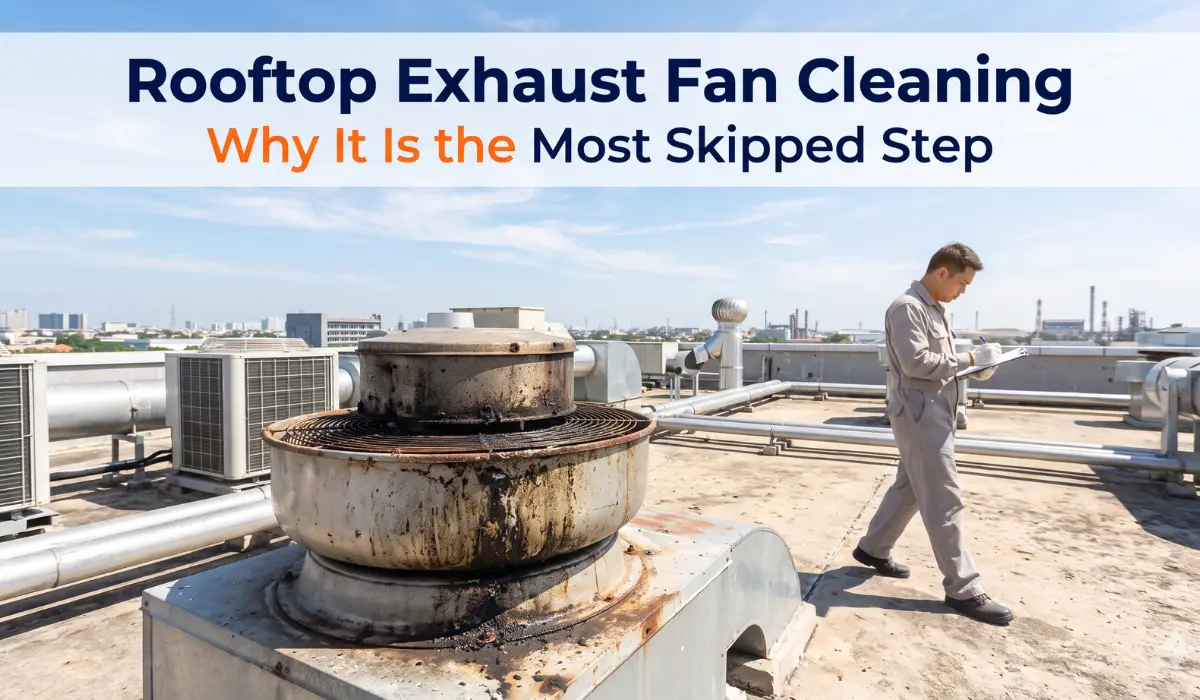
Rooftop Exhaust Fan Cleaning: Why It Is the Most Skipped Step
Your hood is the part of the exhaust system everyone sees. The rooftop fan is the part nobody sees, and that is exactly why it gets skipped.
If your last hood cleaning did not include the roof, your system was not fully cleaned. This post explains why the fan gets missed, what happens when it is ignored, and how to check that your cleaner actually did it.
What the rooftop fan does
The rooftop exhaust fan pulls smoke, heat and grease-laden air out of your kitchen, through the ductwork, and out of the building. Every bit of grease that is not caught by the filters and the duct ends up here.
That makes the fan the final collection point for your kitchen’s grease. A fan coated in buildup is fuel at the end of a duct that leads straight back to your kitchen.
Why it is the most skipped step
It is out of sight. Owners see the hood. They do not climb onto the roof. If nobody reports a problem, nobody checks.
Roof access is a hassle. Many roofs require a ladder, a hatch, or a landlord’s permission. Some cleaners avoid the work because it takes longer and carries more risk.
Low prices leave it out. A cheap quote often covers the hood and filters only. The fan, the duct and the roof are quietly left out, and the price looks better than a full service.
Fans are not built for cleaning. Older fans have no hinge kit. They must be unbolted or tipped by hand, which is slow, heavy and awkward. Some cleaners skip it rather than do it properly.
Owners do not ask. Few restaurant owners think to ask, “Did you clean the fan?” Cleaners that cut corners count on that.
Landlords and tenants point at each other. In leased buildings, nobody is sure who handles roof access, roof damage or fan repair. The job slips between them.
What happens when the fan is not cleaned
Fire risk
Grease builds up in the fan housing, on the blades and in the exhaust path. A flare-up at the grill or the wok can carry heat up the duct and ignite that buildup. A fire at the fan can spread to the roof and the building, and it is one of the hardest places to fight.
Weak ventilation
Grease on the blades throws off the balance and slows the fan. Your kitchen gets hotter and smokier, and your staff feel it before anyone traces it to the roof.
Roof damage
When the fan overflows, grease runs onto the roof. It stains the surface and can break down the roofing membrane. Roof repairs are expensive, and the landlord can bill the tenant.
Failed inspections
Grease staining on the roof around the fan is easy for an inspector to see. If the fan is not clean and accessible, that is a compliance problem you can avoid.
Insurance problems
An insurer can dispute a claim if the exhaust was not maintained to the required standard. If a fire starts or spreads from the fan and your records show no roof cleaning, that gap will matter.
Warning signs your rooftop fan needs cleaning
- Grease stains or dark streaks on the roof around the fan
- Grease dripping from the fan housing or its base
- An overflowing or full grease containment cup
- A fan that is louder, shakier or slower than it used to be
- Smoke or heat lingering in the kitchen
- A burnt or rancid smell near the fan
- No record of anyone cleaning the roof in your service reports
If you see two or more, book a cleaning this week.
What proper rooftop fan cleaning includes
A full service should cover the following:
- Fan housing opened or tipped, using a hinge kit where installed
- Blades, housing and the exhaust path degreased and rinsed
- Grease containment checked, emptied and cleaned
- Duct connection and base inspected for leaks
- Roof surface protected and any spilled grease cleaned up
- Fan belt, motor and bearings checked visually, with problems reported
- Before and after photos of the fan, taken on the roof
The last item is the one that matters. If your cleaner cannot show you roof photos, ask whether the fan was cleaned.
Fix the problem for good: hinge kits and grease containment
Two upgrades make fan cleaning safer, faster and more likely to happen.
Hinged fan kits let the fan tip open for cleaning without being unbolted. That cuts the time and the risk, and it removes the excuse for skipping the job.
Grease containment catches grease before it spills onto the roof. If your fan has none, or the unit is old and cracked, ask your cleaner or a mechanical contractor about adding or replacing it.
Both cost money up front and save you from repeat roof stains and repair disputes later. Talk to your landlord before making changes to the roof.
How often should the fan be cleaned?
The fan belongs on the same schedule as the rest of your system. NFPA 96, which the Ontario Fire Code references for commercial cooking exhaust, sets intervals by cooking type.
| Setup | Typical interval |
| Solid-fuel cooking (wood, charcoal) | Monthly inspection |
| High-volume cooking, including wok and charbroiling | Quarterly |
| Moderate-volume cooking | Semi-annually |
| Low-volume cooking | Annually |
The fan is cleaned every time the system is cleaned. If your fan shows heavy buildup between visits, shorten the interval. Confirm the exact requirement for your kitchen with Toronto Fire Services or your insurer.
How to check your cleaner actually did the roof
Do this after your next service:
- Ask for roof photos. Before and after, with the fan open.
- Look at the service report. It should name the fan, not just the hood.
- Check the sticker and the date. It should cover the full system.
- Go up and look, or ask your landlord’s property manager to. A fan with clean housing and a dry roof around it is a good sign.
- Ask what was left uncleaned. A trustworthy cleaner will tell you about blocked access or damaged equipment.
If your current provider cannot or will not do the roof, find a new one. A price that leaves out the fan is not a discount.
Questions to ask before you hire
- Do you clean the rooftop fan on every visit?
- Do you take photos on the roof?
- Can you work with a hinge kit, or install one?
- What do you do if the grease containment is full or damaged?
- Are you insured for roof work?
Quick action checklist
- Look at your roof fan or ask your landlord for access, and take photos.
- Check your last service report for any mention of the fan.
- Check for grease on the roof around the fan.
- Ask your landlord about a hinge kit and grease containment.
- Book your next full cleaning, and confirm it includes the roof.
Book a full exhaust cleaning in Toronto
Discount Hood Cleaner cleans the whole exhaust system, from the hood to the rooftop fan, across Toronto and the GTA. We work after hours and send you before and after photos from the roof, so you can see the work was done.